What does Hot Isostatic Pressing (HIP) do for Platinum Castings?
TechForm’s proprietary casting process, along with Hot Isostatic Pressing (HIP), virtually eliminates porosity in platinum castings.
Platinum tends to create high levels of micro-porosity during solidification. Micro-porosity increases labor and the possibility of rejection. When applied to platinum, HIP results in a denser microstructure that improves the efficiency of bench operations. Ultimately, the process creates a more durable product, a more secure stone setting, and a longer-lasting luster.
- HIP or Hot Isostatic Pressing Process on Platinum eliminates sub-surface porosity in jewelry castings.
- HIP makes platinum measurably stronger and more ductile due to the increased density.
- Improves the speed and quality of bench operations through denser and more uniform microstructure.
- Provides a more durable product for the consumer.
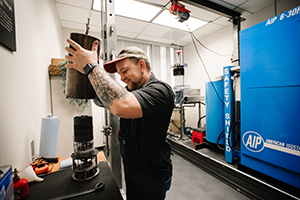
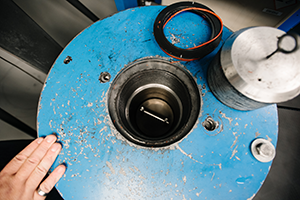
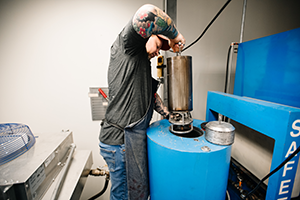
HIP is a high-pressure, high-temperature treatment that is commonly used in quality-critical industries such as medical and aerospace. TechForm uses this process to create high-quality castings for the jewelry industry. The HIP process involves placing the castings into a high-pressure vessel with inert gas and applying pressure at elevated temperatures. The result is densification, which happens when the metal’s creep resistance is surpassed and plastic flows and enables the surrounding material to move into subsurface voids. Time at temperature allows diffusional bonding to occur, which eliminates internal porosity.
Below are magnified images of ring cross-sections showing the interior of a typical 950 PtRu casting before and after HIP. As one can easily see, almost no porosity is left after the HIP treatment.